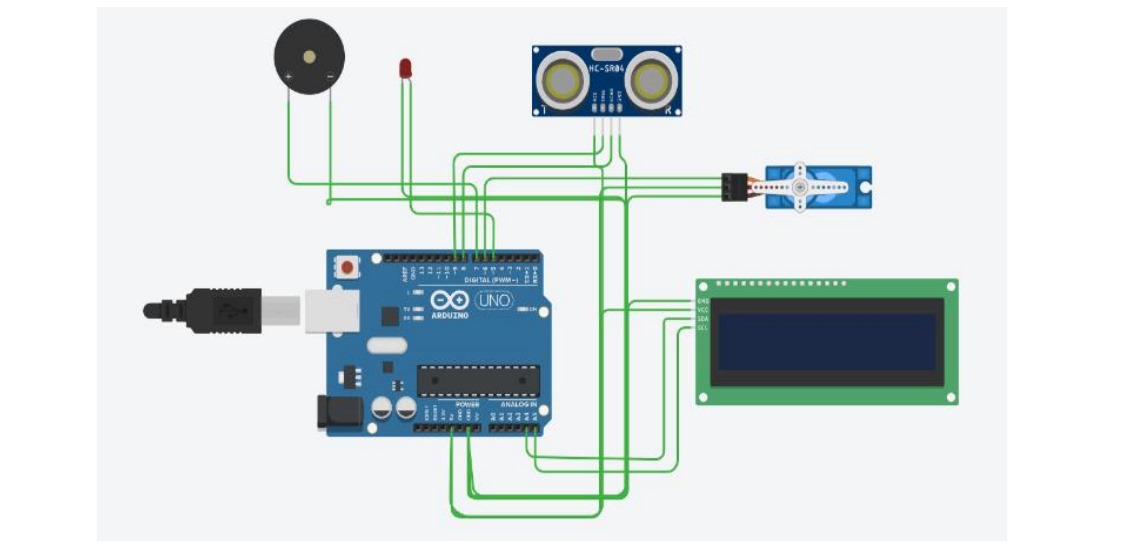
Project Overview
This project involves the design and implementation of a low-cost, scalable Obstacle Detector Circuit using an Arduino Uno microcontroller. The system is designed to sense objects in its environment and provide real-time alerts through visual (LED) and auditory (buzzer) indicators. A key feature is the integration of a servo motor to enable the ultrasonic sensor to scan a wider area, addressing the limitations of fixed-position systems.
Components Utilized
| Component | Quantity |
|---|---|
| Arduino Uno Microcontroller | 1 |
| HC-SR04 Ultrasonic Sensor | 1 |
| Servo Motor (SG90) | 1 |
| Piezo Buzzer | 1 |
| Warning LEDs (Green, Yellow, Red) | 3 |
| Breadboard & Jumper Cables | 1 Set |
Key Features
Technical Implementation
The system's core is the Arduino Uno, which processes data from the HC-SR04 sensor. The sensor emits an ultrasonic pulse and measures the time it takes for the echo to return to calculate the distance to an object. This distance data is then used to control the outputs: a servo motor for scanning and a buzzer and LEDs for alerts. The code synchronizes the sensor data with the servo's motion and triggers alerts based on calibrated thresholds, such as an alert for obstacles within 20cm. Performance analysis showed an accuracy of ±1cm within a 2-meter range and a response time of less than 100 milliseconds.
Project Outcomes & Societal Impact
The project successfully demonstrated an effective sensor-based system that is accurate and efficient. It serves as a functional prototype for real-world applications in robotics, autonomous vehicles, and assistive technologies for the visually impaired. The affordable and low-power design also makes it accessible for educational purposes and beneficial for developing areas.